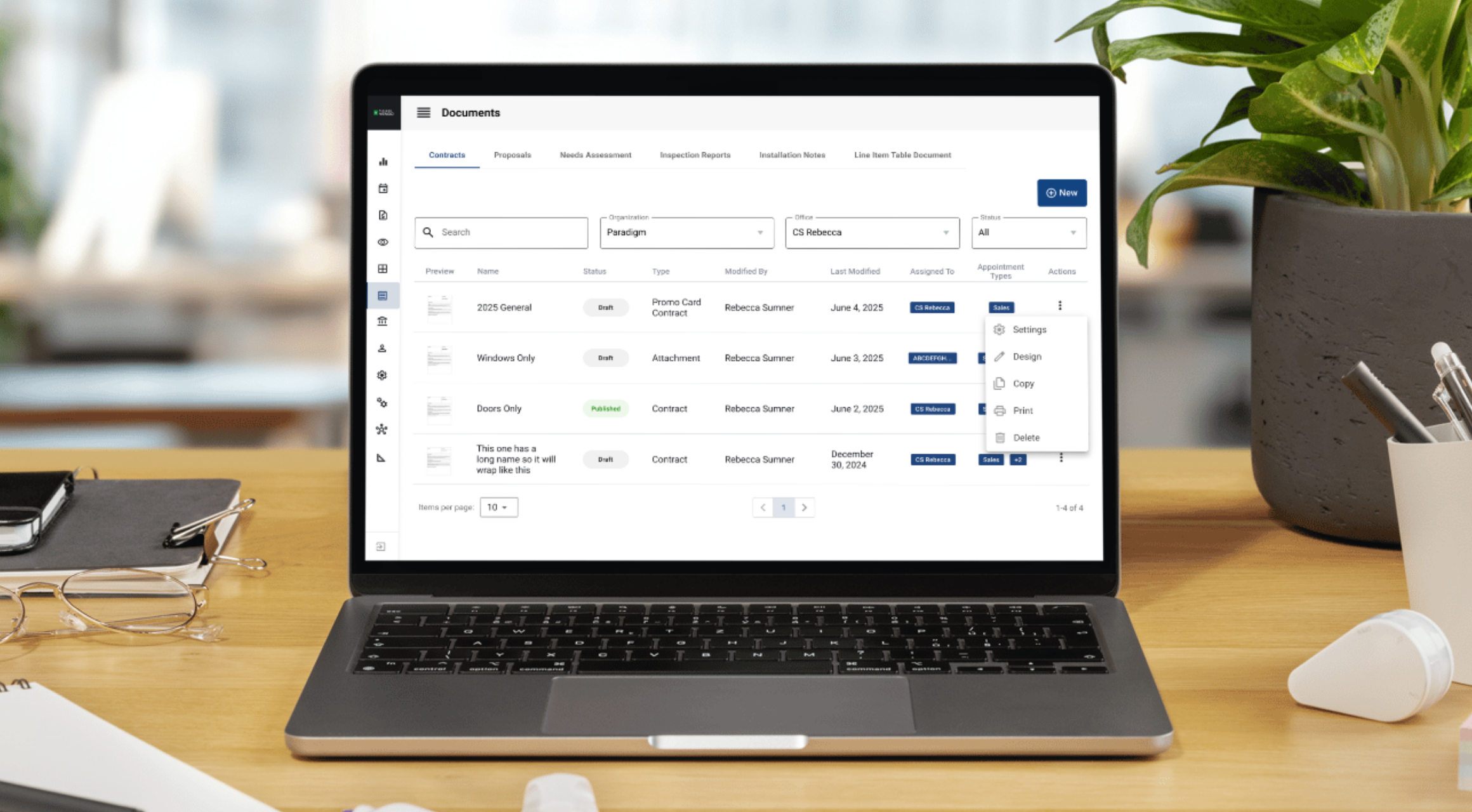
Paradigm delivers software that helps building industry professionals increase sales efficiency, reduce quoting time, and cut operational costs. Its app, Vendo, enables in-home reps to close deals faster and boost conversion rates through a connected, data-driven sales experience.
Sales reps often needed to recreate similar product configurations from scratch, resulting in repetitive work, data inconsistencies, and longer quoting times. The Copy Lines feature was introduced to streamline this process and allow reps to quickly duplicate and modify existing configuration lines and improve efficiency, accuracy, and overall workflow speed.
I collaborated with a cross-functional team of a product manager, developers, and QA engineers to design and validate the Copy Lines feature.
As the product designer, I led user research, workflow mapping, and iterative prototyping to ensure the solution aligned with sales reps' real-world needs and integrated seamlessly into the existing Vendo experience.
Usability testing confirmed that sales reps could complete configurations significantly faster and with fewer errors, reporting that the new flow “felt intuitive and time-saving.”
Dozens of customer success tickets highlighted a recurring pain point: sales reps wanted a faster, more efficient way to copy only some of the configuration lines within a package.
The product consultant and I held customer calls to understand the most common use cases and uncover where the workflow was breaking down. These conversations revealed that the issue was specific to sales reps—not admins—and occurred frequently during the configuration step, where efficiency and accuracy are critical to completing quotes on time.
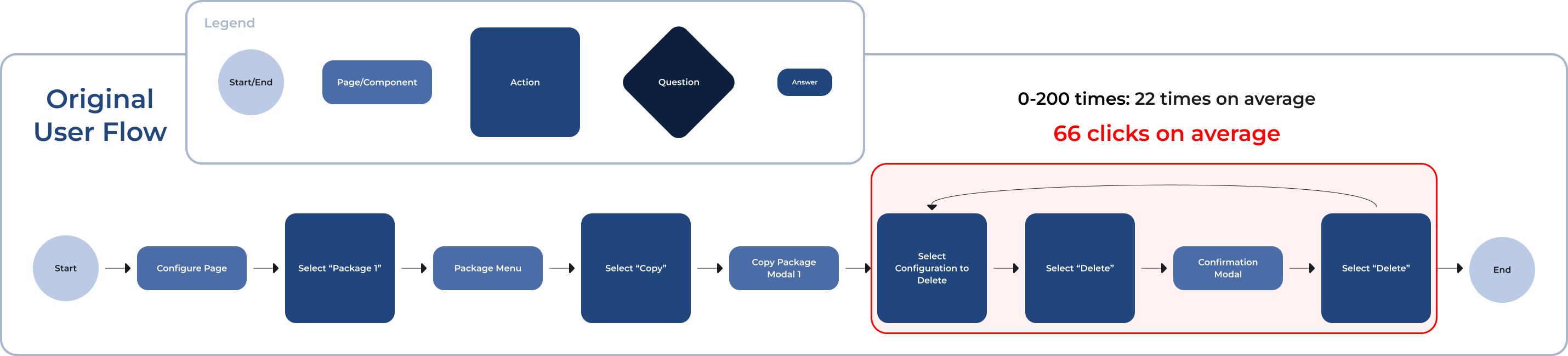
Sales reps lacked an efficient way to reuse only part of a package, forcing them to copy everything and manually delete unwanted lines—adding time, effort, and room for error. I mapped the existing user flow to visualize where friction occurred and quantify how many steps were needed to complete a typical configuration. Using the average of 22 lines deleted (the remaining copied), this step required 66 clicks.
Sales reps need a faster, more flexible way to copy partial configurations within a package to reduce repetitive actions, minimize errors, and accelerate the quoting process.
As a sales rep, I need to copy selected configuration lines from one package to another so that I can build similar quotes more efficiently without recreating or deleting unnecessary line items.
Building on insights from the current workflow, I collaborated with the product manager, product consultant, and developers to explore multiple ways to streamline the process. We sketched and compared several approaches, including full package duplication, line-level copy actions, and a checkbox selection model.
Through Figjam sessions and quick flow iterations, we aligned on the checkbox approach as the most intuitive and technically feasible option - reducing clicks while preserving user control and visibility across complex configurations.

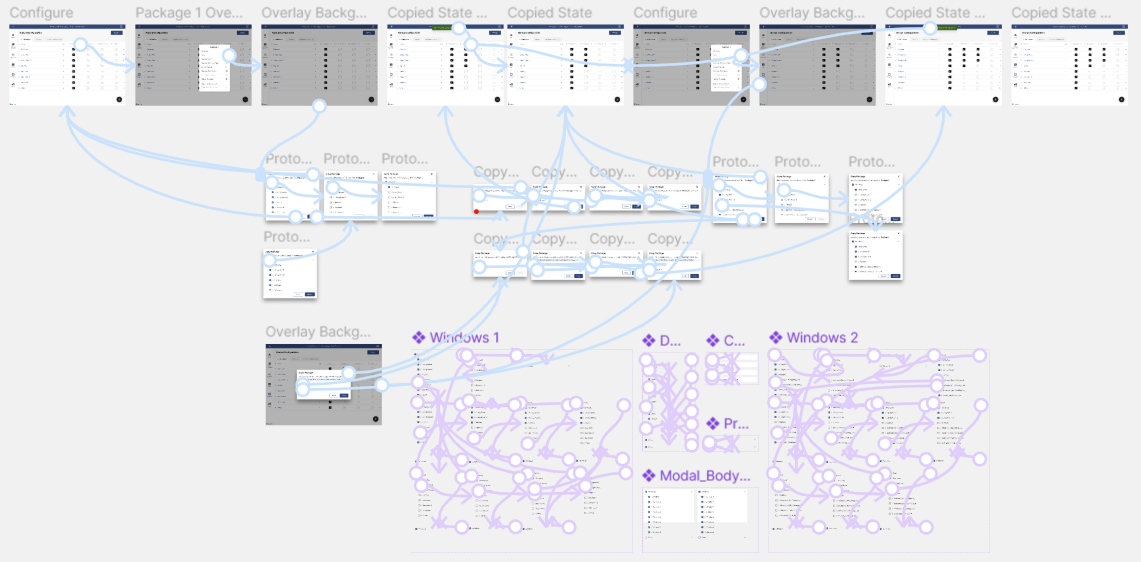
Once the direction was defined, I translated the selected flow into mid-fidelity prototypes in Figma to visualize how sales reps would select, copy, and confirm configuration lines. I focused on clarity and efficiency, using familiar Vendo patterns to minimize cognitive load while introducing new interaction states for multi-selection. These prototypes illustrated each step of the workflow and served as the foundation for stakeholder reviews, cross-team alignment, and developer handoff.
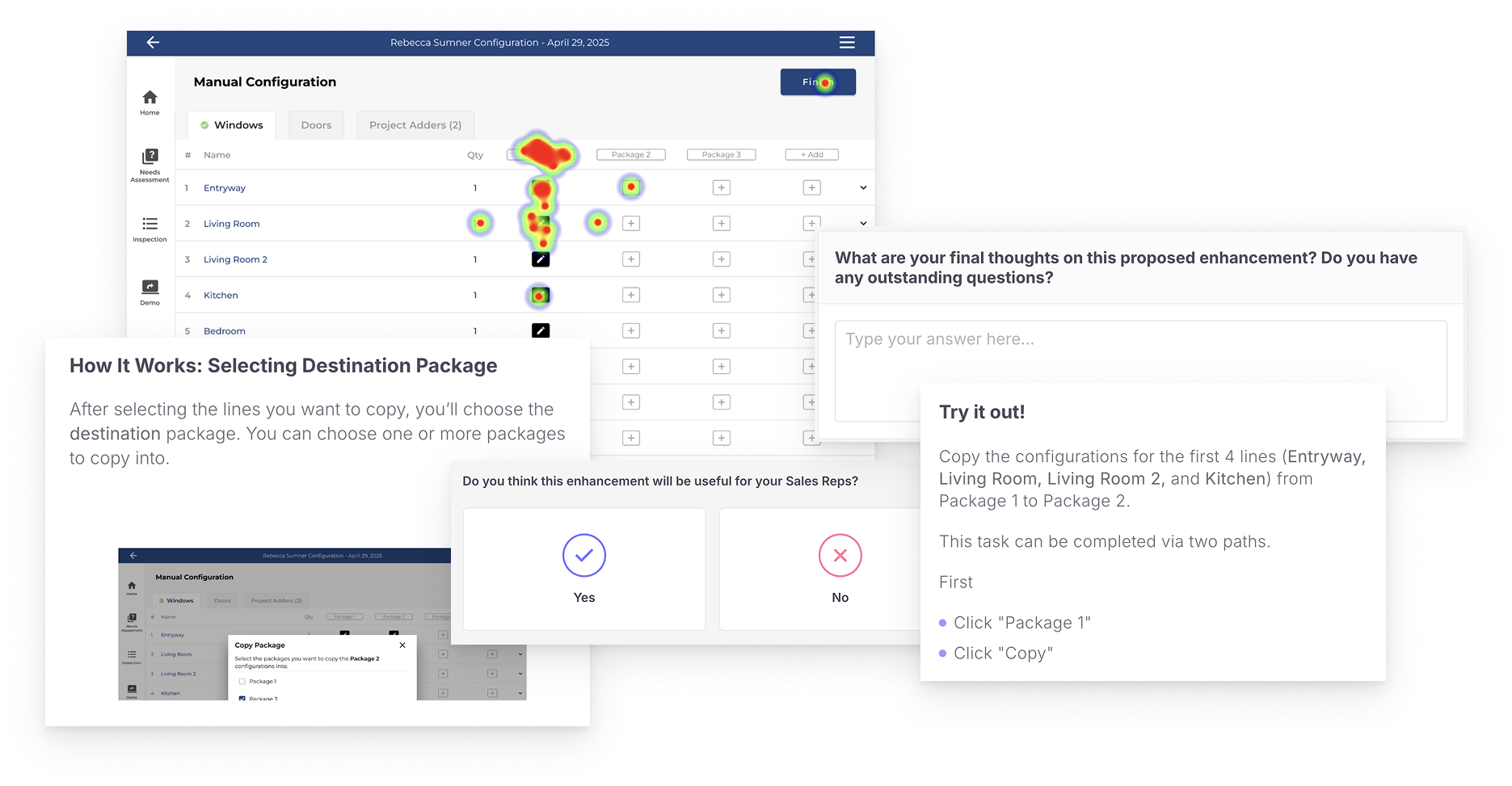
I conducted usability testing sessions via Useberry, with internal and external sales reps to evaluate clarity, efficiency, and alignment with real-world workflows. Participants quickly understood the new flow and described it as intuitive and significantly faster than the old process.
Feedback led to refinements in selection clarity and confirmation messaging, ensuring the feature felt both efficient and reliable. In a likely scenario, copying 20 out of 40 configuration lines, the updated workflow reduced clicks from 63 to 25, resulting in roughly a 60% decrease in user effort.
Streamlined configuration process and reduced manual effort.
Reps built quotes more efficiently with fewer repetitive steps.
This project reminded me that even simple feature requests often mask deeper workflow issues. What started as "a quicker way to copy configurations" revealed broader inefficiencies in the configuration process, showing how valuable it is to trace feedback to its root cause.
Working alongside our product consultant, developers, and sales reps highlighted how collaboration drives clarity. Aligning early across roles helped ensure the final solution balanced user needs, technical feasibility, and business value.
This project encouraged me to think beyond immediate solutions and anticipate future needs. Potential enhancements (like filtered or tagged copying) could streamline workflows even further.
Paradigm delivers software that helps building industry professionals increase sales efficiency, reduce quoting time, and cut operational costs. Its app, Vendo, enables in-home reps to close deals faster and boost conversion rates through a connected, data-driven sales experience.
Sales reps often needed to recreate similar product configurations from scratch, resulting in repetitive work, data inconsistencies, and longer quoting times. The Copy Lines feature was introduced to streamline this process and allow reps to quickly duplicate and modify existing configuration lines and improve efficiency, accuracy, and overall workflow speed.
I collaborated with a cross-functional team of a product manager, developers, and QA engineers to design and validate the Copy Lines feature.
As the product designer, I led user research, workflow mapping, and iterative prototyping to ensure the solution aligned with sales reps' real-world needs and integrated seamlessly into the existing Vendo experience.
Usability testing confirmed that sales reps could complete configurations significantly faster and with fewer errors, reporting that the new flow “felt intuitive and time-saving.”
Dozens of customer success tickets highlighted a recurring pain point: sales reps wanted a faster, more efficient way to copy only some of the configuration lines within a package.
The product consultant and I held customer calls to understand the most common use cases and uncover where the workflow was breaking down. These conversations revealed that the issue was specific to sales reps—not admins—and occurred frequently during the configuration step, where efficiency and accuracy are critical to completing quotes on time.
Sales reps lacked an efficient way to reuse only part of a package, forcing them to copy everything and manually delete unwanted lines—adding time, effort, and room for error. I mapped the existing user flow to visualize where friction occurred and quantify how many steps were needed to complete a typical configuration. Using the average of 22 lines deleted (the remaining copied), this step required 66 clicks.
Sales reps need a faster, more flexible way to copy partial configurations within a package to reduce repetitive actions, minimize errors, and accelerate the quoting process.
As a sales rep, I need to copy selected configuration lines from one package to another so that I can build similar quotes more efficiently without recreating or deleting unnecessary line items.
Building on insights from the current workflow, I collaborated with the product manager, product consultant, and developers to explore multiple ways to streamline the process. We sketched and compared several approaches, including full package duplication, line-level copy actions, and a checkbox selection model.
Through Figjam sessions and quick flow iterations, we aligned on the checkbox approach as the most intuitive and technically feasible option - reducing clicks while preserving user control and visibility across complex configurations.
Once the direction was defined, I translated the selected flow into mid-fidelity prototypes in Figma to visualize how sales reps would select, copy, and confirm configuration lines. I focused on clarity and efficiency, using familiar Vendo patterns to minimize cognitive load while introducing new interaction states for multi-selection. These prototypes illustrated each step of the workflow and served as the foundation for stakeholder reviews, cross-team alignment, and developer handoff.
I conducted usability testing sessions via Useberry, with internal and external sales reps to evaluate clarity, efficiency, and alignment with real-world workflows. Participants quickly understood the new flow and described it as intuitive and significantly faster than the old process.
Feedback led to refinements in selection clarity and confirmation messaging, ensuring the feature felt both efficient and reliable. In a likely scenario, copying 20 out of 40 configuration lines, the updated workflow reduced clicks from 63 to 25, resulting in roughly a 60% decrease in user effort.
Streamlined configuration process and reduced manual effort.
Reps built quotes more efficiently with fewer repetitive steps.
This project reminded me that even simple feature requests often mask deeper workflow issues. What started as "a quicker way to copy configurations" revealed broader inefficiencies in the configuration process, showing how valuable it is to trace feedback to its root cause.
Working alongside our product consultant, developers, and sales reps highlighted how collaboration drives clarity. Aligning early across roles helped ensure the final solution balanced user needs, technical feasibility, and business value.
This project encouraged me to think beyond immediate solutions and anticipate future needs. Potential enhancements (like filtered or tagged copying) could streamline workflows even further.
Paradigm delivers software that helps building industry professionals increase sales efficiency, reduce quoting time, and cut operational costs. Its app, Vendo, enables in-home reps to close deals faster and boost conversion rates through a connected, data-driven sales experience.
Sales reps often needed to recreate similar product configurations from scratch, resulting in repetitive work, data inconsistencies, and longer quoting times. The Copy Lines feature was introduced to streamline this process and allow reps to quickly duplicate and modify existing configuration lines and improve efficiency, accuracy, and overall workflow speed.
I collaborated with a cross-functional team of a product manager, developers, and QA engineers to design and validate the Copy Lines feature.
As the product designer, I led user research, workflow mapping, and iterative prototyping to ensure the solution aligned with sales reps' real-world needs and integrated seamlessly into the existing Vendo experience.
Usability testing confirmed that sales reps could complete configurations significantly faster and with fewer errors, reporting that the new flow “felt intuitive and time-saving.”
Dozens of customer success tickets highlighted a recurring pain point: sales reps wanted a faster, more efficient way to copy only some of the configuration lines within a package.
The product consultant and I held customer calls to understand the most common use cases and uncover where the workflow was breaking down. These conversations revealed that the issue was specific to sales reps—not admins—and occurred frequently during the configuration step, where efficiency and accuracy are critical to completing quotes on time.
Sales reps lacked an efficient way to reuse only part of a package, forcing them to copy everything and manually delete unwanted lines—adding time, effort, and room for error. I mapped the existing user flow to visualize where friction occurred and quantify how many steps were needed to complete a typical configuration. Using the average of 22 lines deleted (the remaining copied), this step required 66 clicks.
Sales reps need a faster, more flexible way to copy partial configurations within a package to reduce repetitive actions, minimize errors, and accelerate the quoting process.
As a sales rep, I need to copy selected configuration lines from one package to another so that I can build similar quotes more efficiently without recreating or deleting unnecessary line items.
Building on insights from the current workflow, I collaborated with the product manager, product consultant, and developers to explore multiple ways to streamline the process. We sketched and compared several approaches, including full package duplication, line-level copy actions, and a checkbox selection model.
Through Figjam sessions and quick flow iterations, we aligned on the checkbox approach as the most intuitive and technically feasible option - reducing clicks while preserving user control and visibility across complex configurations.
Once the direction was defined, I translated the selected flow into mid-fidelity prototypes in Figma to visualize how sales reps would select, copy, and confirm configuration lines. I focused on clarity and efficiency, using familiar Vendo patterns to minimize cognitive load while introducing new interaction states for multi-selection. These prototypes illustrated each step of the workflow and served as the foundation for stakeholder reviews, cross-team alignment, and developer handoff.
I conducted usability testing sessions via Useberry, with internal and external sales reps to evaluate clarity, efficiency, and alignment with real-world workflows. Participants quickly understood the new flow and described it as intuitive and significantly faster than the old process.
Feedback led to refinements in selection clarity and confirmation messaging, ensuring the feature felt both efficient and reliable. In a likely scenario, copying 20 out of 40 configuration lines, the updated workflow reduced clicks from 63 to 25, resulting in roughly a 60% decrease in user effort.
Streamlined configuration process and reduced manual effort.
Reps built quotes more efficiently with fewer repetitive steps.
This project reminded me that even simple feature requests often mask deeper workflow issues. What started as "a quicker way to copy configurations" revealed broader inefficiencies in the configuration process, showing how valuable it is to trace feedback to its root cause.
Working alongside our product consultant, developers, and sales reps highlighted how collaboration drives clarity. Aligning early across roles helped ensure the final solution balanced user needs, technical feasibility, and business value.
This project encouraged me to think beyond immediate solutions and anticipate future needs. Potential enhancements (like filtered or tagged copying) could streamline workflows even further.
Paradigm delivers software that helps building industry professionals increase sales efficiency, reduce quoting time, and cut operational costs. Its app, Vendo, enables in-home reps to close deals faster and boost conversion rates through a connected, data-driven sales experience.
Sales reps often needed to recreate similar product configurations from scratch, resulting in repetitive work, data inconsistencies, and longer quoting times. The Copy Lines feature was introduced to streamline this process and allow reps to quickly duplicate and modify existing configuration lines and improve efficiency, accuracy, and overall workflow speed.
I collaborated with a cross-functional team of a product manager, developers, and QA engineers to design and validate the Copy Lines feature.
As the product designer, I led user research, workflow mapping, and iterative prototyping to ensure the solution aligned with sales reps' real-world needs and integrated seamlessly into the existing Vendo experience.
Usability testing confirmed that sales reps could complete configurations significantly faster and with fewer errors, reporting that the new flow “felt intuitive and time-saving.”
Dozens of customer success tickets highlighted a recurring pain point: sales reps wanted a faster, more efficient way to copy only some of the configuration lines within a package.
The product consultant and I held customer calls to understand the most common use cases and uncover where the workflow was breaking down. These conversations revealed that the issue was specific to sales reps—not admins—and occurred frequently during the configuration step, where efficiency and accuracy are critical to completing quotes on time.
Sales reps lacked an efficient way to reuse only part of a package, forcing them to copy everything and manually delete unwanted lines—adding time, effort, and room for error. I mapped the existing user flow to visualize where friction occurred and quantify how many steps were needed to complete a typical configuration. Using the average of 22 lines deleted (the remaining copied), this step required 66 clicks.
Sales reps need a faster, more flexible way to copy partial configurations within a package to reduce repetitive actions, minimize errors, and accelerate the quoting process.
As a sales rep, I need to copy selected configuration lines from one package to another so that I can build similar quotes more efficiently without recreating or deleting unnecessary line items.
Building on insights from the current workflow, I collaborated with the product manager, product consultant, and developers to explore multiple ways to streamline the process. We sketched and compared several approaches, including full package duplication, line-level copy actions, and a checkbox selection model.
Through Figjam sessions and quick flow iterations, we aligned on the checkbox approach as the most intuitive and technically feasible option - reducing clicks while preserving user control and visibility across complex configurations.
Once the direction was defined, I translated the selected flow into mid-fidelity prototypes in Figma to visualize how sales reps would select, copy, and confirm configuration lines. I focused on clarity and efficiency, using familiar Vendo patterns to minimize cognitive load while introducing new interaction states for multi-selection. These prototypes illustrated each step of the workflow and served as the foundation for stakeholder reviews, cross-team alignment, and developer handoff.
I conducted usability testing sessions via Useberry, with internal and external sales reps to evaluate clarity, efficiency, and alignment with real-world workflows. Participants quickly understood the new flow and described it as intuitive and significantly faster than the old process.
Feedback led to refinements in selection clarity and confirmation messaging, ensuring the feature felt both efficient and reliable. In a likely scenario, copying 20 out of 40 configuration lines, the updated workflow reduced clicks from 63 to 25, resulting in roughly a 60% decrease in user effort.
Streamlined configuration process and reduced manual effort.
Reps built quotes more efficiently with fewer repetitive steps.
This project reminded me that even simple feature requests often mask deeper workflow issues. What started as "a quicker way to copy configurations" revealed broader inefficiencies in the configuration process, showing how valuable it is to trace feedback to its root cause.
Working alongside our product consultant, developers, and sales reps highlighted how collaboration drives clarity. Aligning early across roles helped ensure the final solution balanced user needs, technical feasibility, and business value.
This project encouraged me to think beyond immediate solutions and anticipate future needs. Potential enhancements (like filtered or tagged copying) could streamline workflows even further.
